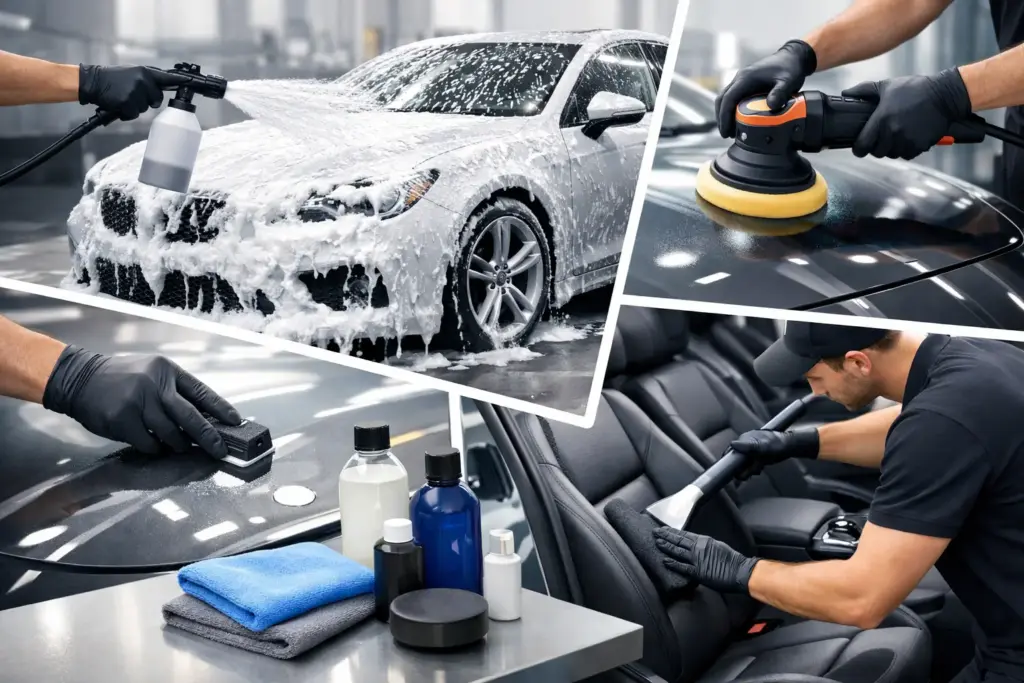
A wash bay loses money every time road film stays on the vehicle after the first pass. The Finnish search phrase auton pesuaineet ammattikäyttöön refers to professional-grade car wash chemicals built for repeatable results: fast soil removal, controlled dilution, clean rinsing, and a finish customers can see immediately. For detailers, fleet operators, repair shops, and high-volume washes, the right chemical system reduces labor without sacrificing paint, trim, glass, or interior materials.
Professional products are not simply larger containers of consumer chemicals. They must perform consistently across dozens or hundreds of vehicles, work with the equipment already in the bay, and keep cost per wash under control. That means choosing products by task, contamination type, surface, and water conditions rather than relying on one all-purpose bottle.
Auton pesuaineet ammattikäyttöön start with the wash process
A reliable professional wash starts before the wash mitt, brush, or shampoo touches the paint. Most visible grime is a combination of mineral dust, traffic film, salt, oily residue, insects, brake dust, and organic material. Trying to remove all of it with a single shampoo often means more mechanical contact, more time, and a higher risk of swirls.
The practical approach is a staged process. Begin with a pre-wash chemical that loosens heavy contamination, then use active foam to keep the product working on vertical panels. Rinse thoroughly before moving to contact washing. This sequence removes much of the abrasive dirt before brushes or mitts reach the surface.
For a busy wash operation, this matters more than a dramatic foam display. Thick foam can be useful because it increases dwell time, but cleaning ability, safe dilution, and clean rinsing are the factors that determine whether the product earns its place in the process.
Pre-wash chemicals for road film and winter dirt
Pre-wash products are the workhorses of professional exterior cleaning. They are designed to break down the traffic film that standard shampoo may leave behind, especially around lower doors, rear panels, wheel arches, bumpers, and commercial vehicle surfaces.
Alkaline pre-washes are often effective against oily road grime, salt, and general film. They are a strong choice for winter conditions, fleet maintenance, and neglected vehicles. Their strength also requires discipline. Overconcentration, excessive dwell time, or allowing the product to dry can affect sensitive trim, unprotected finishes, and polished metal.
Use the lowest concentration that delivers the required result. A lightly soiled maintenance wash needs a different mix from a van that has spent weeks on salted roads. This protects surfaces, reduces chemical consumption, and makes results easier to repeat between employees.
Active foam improves coverage, not just appearance
Active foam helps distribute cleaning chemistry across the vehicle. It is especially useful on vertical body panels where a thin liquid pre-wash can run off too quickly. Applied through a foam lance, foam cannon, or compatible low-pressure system, it gives the chemical time to soften contamination before rinsing.
The best active foam for professional use depends on the rest of the system. A stronger foam may be ideal for a touchless service or heavily soiled work vehicles. A gentler, pH-balanced option can be better for regular maintenance washes, ceramic-coated vehicles, and customers who expect frequent detailing.
Do not judge foam only by how long it clings. If it takes too long to rinse or leaves residue in badges, seals, and panel gaps, it adds work. The target is efficient soil removal followed by a clean rinse.
Choose shampoo based on lubrication and finish quality
After the pre-wash and rinse, car shampoo handles the remaining soil during contact washing. At this stage, lubrication is essential. A shampoo that provides good glide helps the wash mitt move across paint with less friction, reducing the chance of fine wash marks.
For professional operations, concentrate performance is equally important. A concentrated shampoo can lower the cost per vehicle and simplify inventory, provided the dilution instructions are followed accurately. Using more product than necessary rarely improves the wash. It increases cost and can make rinsing harder.
A neutral or paint-safe shampoo is usually the right choice for maintained vehicles, waxed paint, sealants, and polymer protection. Stronger cleaners should be reserved for specific contamination problems, not used as the default for every service.
Separate wheel, insect, glass, and interior cleaning tasks
The fastest professional workflows use dedicated products where they produce a clear advantage. Wheels, windshields, upholstery, leather, and engine-bay surfaces collect different kinds of dirt. One general cleaner may work adequately in several places, but it rarely performs at its best everywhere.
Wheel contamination often contains bonded brake dust and road film. Use a wheel cleaner suited to the wheel finish, then agitate only when needed with appropriate brushes. Avoid treating all wheels as identical. Painted, polished, chrome, matte, and coated wheels can respond differently to aggressive chemistry.
Insect remover is useful before pre-wash on front bumpers, mirrors, windshield edges, and grille areas. It softens protein-based residue that can otherwise require excessive scrubbing. The key is short dwell time and a thorough rinse, particularly in warm weather.
Glass cleaners should leave no oily film or smearing, especially on the inside of windshields. This is a small detail with a large effect on customer satisfaction. Streaks become obvious under headlights, low sun, and wet-road glare.
For interiors, use cleaners that match the material. Fabric and carpet need soil removal without overwetting. Leather needs a cleaner that lifts body oils and everyday dirt without leaving a slippery residue. Plastic and vinyl surfaces benefit from a finish that looks clean and even rather than artificially glossy.
Protection is part of a profitable wash service
A clean vehicle looks better when water beads, paint reflects evenly, and plastic trim does not appear faded. Protection products add value to a professional wash while making future cleaning easier. Quick waxes and polymer-based protectants can be applied after washing to improve gloss and water behavior without adding the time required for a full correction or coating service.
The right protection level depends on the customer and the service package. A fleet vehicle may need fast, practical protection that supports easier maintenance. A detailing customer may want a more durable polymer treatment or a dedicated glass coating for improved visibility in rain. For a wash subscription customer, a quick protective finish may be the most sensible balance of speed and visible result.
Be clear about what each product can deliver. A spray protectant is not the same as a long-term coating. Setting the right expectation prevents callbacks and builds trust.
Manage dilution, storage, and staff consistency
Large-format professional chemicals deliver better operating economics only when they are managed properly. Five-gallon, 20-kilogram, and larger containers make sense for busy operations, but they require a clear handling routine. Label every secondary bottle and dilution station with the product name, ratio, intended surface, and basic safety instructions.
Use measuring tools or dosing equipment instead of estimating by eye. Small concentration errors multiply quickly across a high-volume operation. Too weak, and the chemical fails to remove dirt. Too strong, and it wastes product, increases rinse time, and may create avoidable surface risk.
Storage conditions also matter. Keep containers sealed, organized, and protected from extreme temperatures. Train staff to apply chemicals to cool surfaces whenever possible, avoid direct sun, never let products dry on the vehicle, and rinse from top to bottom after the appropriate dwell time.
Build a chemical lineup around real vehicle volume
A small detailing studio may need compact, versatile products with premium finish quality. A dealership reconditioning department needs predictable results across varied trade-ins. A fleet operator may prioritize rapid road-film removal, bulk packaging, and easy staff training. The best professional lineup is not necessarily the largest one. It is the one that covers daily jobs without overlapping products or complicated decisions.
Start with a dependable pre-wash, active foam, contact shampoo, wheel cleaner, glass cleaner, interior cleaner, and a quick protectant. Add specialty products such as insect remover, de-icer, leather cleaner, or stronger degreasers when the workload justifies them. This keeps the wash process clear, controllable, and easy to scale.
The visible result matters, but so does the process behind it. When chemicals are selected for the contamination, surface, and equipment in use, every wash becomes faster to deliver, easier to price, and more likely to bring the vehicle back clean, glossy, and ready for the next customer.
https://shorturl.fm/Pp9sN
Solid overview! Any recommended reads about comfortable materials?