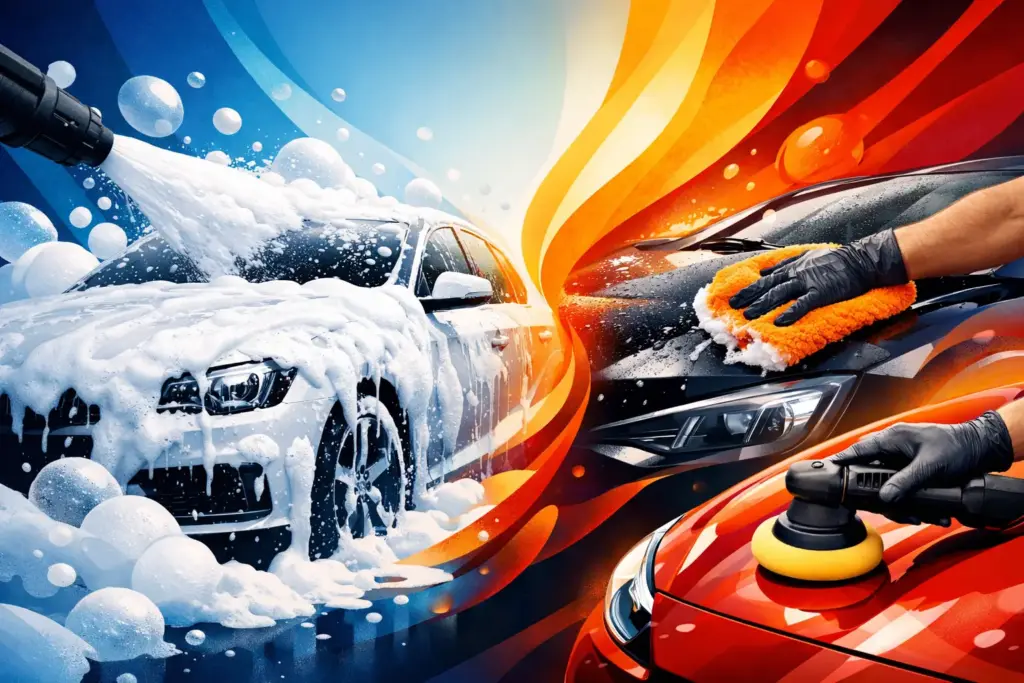
A clean car can still have wash-induced swirl marks if the dirt removal order is wrong. That is why the question aktiivivaahto vai autoshampoo is not really about choosing one product over the other. Active foam and car shampoo do different jobs. Used in the right order, they remove more grime while reducing unnecessary contact with the paint.
For routine maintenance, active foam is the first step that loosens and carries away road film. Car shampoo is the contact-wash step that finishes the job. If your vehicle sees winter salt, wet roads, insects, brake dust, or long highway miles, using both products gives a noticeably cleaner result than relying on one alone.
Active Foam vs. Car Shampoo: The Core Difference
Active foam is a pre-wash chemical designed to cling to exterior surfaces. It softens traffic film, mud, salt residue, pollen, and loose dirt before a wash mitt touches the paint. Applied with a foam cannon, foam lance, pump sprayer, or compatible pressure-washer setup, it gives the chemistry time to work where the vehicle is dirtiest: the lower doors, rocker panels, rear hatch, front bumper, wheels, and mirrors.
Car shampoo is designed for lubricated hand washing. It helps a quality wash mitt glide across the paint while lifting the dirt that remains after pre-washing. Good shampoo creates controlled suds and rinse behavior, but its most important job is lubrication. That lubrication reduces the risk that remaining grit will drag across the clear coat.
Think of active foam as dirt removal before contact. Think of shampoo as safe cleaning during contact. One cannot fully replace the other when you want the best finish.
When Active Foam Is the Better Choice
Choose active foam first when the car has visible road grime or has been driven in demanding conditions. This is especially true after winter driving, rain-soaked commutes, gravel roads, or long-distance travel. Salt and abrasive road film collect heavily on lower panels, and taking a mitt directly to those areas is one of the quickest ways to create fine scratches.
A foam pre-wash is also the practical answer when time is limited. If the car is only lightly dusty and you do not need a full detail-level wash, active foam followed by a thorough rinse can improve the appearance without a full hand wash. This is commonly called a touchless maintenance wash.
There is a trade-off. Touchless washing is fast and lowers contact risk, but it may leave behind bonded dirt, greasy film, and grime around badges, door handles, and rear panels. It is excellent for maintenance, not always for a fully clean finish.
Active foam works best when the surface is cool and out of direct sunlight. Rinse loose debris first if the vehicle is heavily muddy. Then apply foam evenly from the lower sections upward, allowing you to see where coverage is needed. Let it dwell according to the product directions, but never let it dry on the surface. Rinse thoroughly, working from top to bottom.
When Car Shampoo Is Necessary
Use car shampoo whenever the vehicle needs more than a quick maintenance wash. If you can still see a dull film after rinsing the foam, if the paint feels rough, or if dirt remains around the rear of the vehicle, shampoo is the next step.
A shampoo wash is also the right choice before applying a spray wax, polymer protection, sealant, or other finishing product. Protection adheres and performs better on a properly cleaned surface. Applying protection over remaining road film may give temporary shine, but it will not deliver the clean, slick finish you expect.
Use a clean wash mitt rather than a sponge or old towel. A mitt holds more wash solution and releases dirt more safely when rinsed. Work in small sections, starting with the roof, glass, hood, and upper doors. Leave the dirtiest lower sections and rear bumper until last. Rinse the mitt frequently in a separate rinse bucket or under clean running water.
Shampoo alone is acceptable when the vehicle is lightly dusty and has not been exposed to salt, mud, or gritty road conditions. Even then, a quick pre-rinse is essential. Never use shampoo as an excuse to rub dry dust directly across the paint.
Foam Does Not Mean “Clean” by Itself
Thick foam looks effective, but appearance is not the only measure of cleaning performance. Dwell time, chemical formulation, dilution ratio, water pressure, and the type of contamination all matter. A foam that clings well but does not loosen road film is less useful than a correctly diluted product that rinses dirt away efficiently.
The same applies to shampoo suds. More bubbles do not automatically mean better lubrication or cleaning. Follow the recommended dilution. Overconcentrating products can make rinsing harder, waste chemical, and leave residue on trims or glass.
The Best Wash Order for Most Vehicles
For a thorough and paint-safe wash, use active foam and shampoo together. This process works for daily drivers, enthusiast vehicles, SUVs, vans, and work fleets.
Start by cleaning wheels and tires with dedicated products and separate brushes. Wheel dirt can contain sharp brake dust, so do not use the same mitt or bucket on painted panels afterward. If the wheels are hot, let them cool before applying any cleaner.
Next, rinse the full vehicle to remove loose mud and grit. Apply active foam over the exterior and allow it to dwell without drying. Rinse it off completely. At this point, much of the abrasive contamination should already be gone.
Then wash with car shampoo and a clean mitt. Use straight, overlapping passes instead of aggressive circular scrubbing. Rinse each section before moving on if conditions are warm. Finish with a full rinse, then dry with a clean microfiber drying towel or a touchless air dryer.
This sequence may take a few minutes longer than a single-product wash, but it saves time compared with correcting swirls, polishing haze, or repeatedly washing panels that were never fully cleaned in the first place.
Adjust the Method to the Season and the Vehicle
In winter, active foam earns its place because road salt and slush build up quickly. Focus on wheel arches, rocker panels, lower doors, and the rear of the vehicle. Frequent touchless foam washes between full shampoo washes can help keep buildup under control. Do not forget the door jambs and fuel door area when conditions allow.
In summer, insects, pollen, tree residue, and dust are the usual problems. Foam loosens fresh bug splatter, but dried insect residue may need a dedicated pre-treatment. Shampoo then removes the remaining film safely before it has time to bake into the finish.
For ceramic-coated, waxed, or polymer-protected vehicles, use a surface-safe active foam and a pH-balanced shampoo unless the contamination calls for a stronger product. Harsh cleaning is sometimes necessary for heavy grime, but regular use of overly aggressive chemistry can reduce the behavior and longevity of protective layers.
Work vehicles and commercial fleets often need a different balance. The priority may be speed, consistent results, and economical dilution rather than a show-car finish every week. Larger chemical containers and efficient foam application make sense here, while a scheduled shampoo wash can handle the deeper cleaning intervals.
Common Mistakes That Reduce Results
The biggest mistake is applying foam or shampoo to hot paint in direct sun. Heat shortens dwell time and can cause products to dry too quickly. Another common mistake is using a dirty mitt repeatedly without rinsing it. Once grit is trapped in the fibers, it becomes a risk to the clear coat.
Avoid using household dish soap as a substitute for car shampoo. It may cut grease, but it is not designed for paint lubrication or routine vehicle care. It can also strip waxes and leave the surface less protected.
Finally, do not skip drying. Water spots can form when mineral-rich water evaporates, especially on dark paint and glass. A clean microfiber towel removes water safely and leaves the finish ready for a quick detailer or protective product if desired.
Which Product Should You Buy First?
If you can buy only one product right now, choose based on your washing method. Pick active foam if you use a pressure washer, frequently deal with road grime, or want a fast touchless maintenance option. Pick car shampoo if you regularly wash by hand and need a lubricated cleaner for a complete wash.
For the best all-around setup, keep both on hand. ClearShine Solutions offers active foam and car shampoo options for home users as well as larger-volume professional use, making it easier to match the product size to your wash frequency.
The practical answer is simple: foam first when dirt needs to come off without rubbing, shampoo next when the finish needs a true hand wash. Give each product its proper role, and your paint will stay cleaner, glossier, and easier to protect over time.
Helpful stuff, will definitely try this out.